Leaving India, we sailed through the Indian Ocean, into the Arabian Sea and then the Gulf of Oman to dock in the Sultanate of Oman’s capital, Muscat. Just the description sounds so absurdly romantic! (Oman and its neighbor to the south, Yemen, share the bottom of Saudi Arabia…on the opposite shore from Muscat is Iran…we have considered just taping pages of the Atlas to us.) What a splendid looking place – just like a Middle East country should look! Portuguese forts built in the late 16th C overlook the harbor.

Wooden dhows were at anchor in the harbor. This type of ship has ploughed the waters around the Middle East since trading started eons ago. (Poised at Muscat is, geographically, it has been an active port more or less forever.)

About the size of Italy but with far, far fewer people, modernity has been slow to arrive in Oman tho some of the good things that come with the 20th/21st C have been introduced – with alacrity. Oman has a fascinating history of ups and downs. As far back as 5000 BC, Oman was at the center of the frankincense trade (this is where the Queen of Sheba got her gift of it for King Solomon); it is sap from frankincense trees! Copper then became king…but the country became isolated until Islam was introduced in the 7th C. It then puttered along and was engulfed by the Portuguese for about 150 years till mid 17th C. The Portuguese were only interested in the coast (from which they could control their maritime interests) and never went inland; after they were driven off, things improved and by the19th C, Oman had created quite an empire – including Zanzibar and Mombasa in Africa and parts of India. It went downhill again and sunk into another period of isolation, kept that way by the father of the current Sultan who was afraid of his country losing its traditional values.
However, trouble was brewing in the 60’s mostly due to Marxist guerillas encouraged by neighbor Yemen and, to ward them off, a more or less bloodless palace coup occurred (the old Sultan was shot in the foot, deposed and packed off to England). The son (educated in England) then built hospitals and schools and created a more up to date infrastructure (roads) and opened his country up to tourism. Thus, we are here. There is only limited oil here so Oman has not gone the way of Abu Dhabi and Dubai…Omanis (both sexes) do their own work and the country is doing nicely, not over the top like its UAE neighbors. It got our vote. Nice main street with parking set aside for the Imam.


Bill’s first excursion since he developed pneumonia weeks back took us outside of the city to the Sultan Qaboos Grand Mosque. However, we infidels arrived too late in the AM to be allowed inside and had to content ourselves with just looking at the structure and the date palm oasis in which it sits (dates are still a major export).


We also visited the modern government buildings…the people were much more fun to see.

Muscat Museum which had walls devoted to firearms as Oman used to generate a chunk of its revenue from arms sales.

I can’t say we were particularly struck by anything probably due to the stampeding hordes of Asian tourists; photos were verboten…something I didn’t realize at first.
One of the sources of Oman’s money in the distant past – but still on offer – is frankincense and myrr! So, when we visited the souk, that was what we saw a lot of. We also saw a great many men in their white shirt dress (dishdasha) and small fitted brimless headgear. The women were all wearing abeyyas but face covering styles vary (the photo with the two women has a handsome backdrop of Muscat). Bill’s scooter drew a lot of attention and started a number of conversations.


And for reasons undivined, the ship spent the night in port, leaving in the AM. There was a sand storm afoot so the photos in the early light were quite ethereal. I got a little carried away with the photos. (I recently took a class on board in how to take better photos of structures…not sure if it shows.)


We then headed for Abu Dhabi (which means Father of the Gazelle of which there used to be many but now they hide up in the hills). To get here from Oman we sailed west thru the Strait of Hormuz in the daylight and perhaps that was part of the reason we stayed overnight in Oman. We are now in the Persian Gulf!
There are seven states in the federation that make up the UAE but all except the two we are going to see were completely unknown to our ears. Large – really large – photos of the sheikhs who head the states are publicly displayed (the one running down the side of a modern building is of all seven; the other we think is of the main movers and shakers, the heads of Dubai and Abu Dhabi).


Abu Dhabi and Dubai were rather small potatoes for a long time, with the pearl industry being a major revenue generator until the Japanese came up with cultured pearls in the 1930’s and decimated it; fishing and dhow building were also part of the economy. Britain had agreements/truces with all of the Emirates (collectively known as the Trucial States, protection in return for exclusive rights) but these withered in the 1960’s.
Bill stayed on the ship today, resting for Dubai. The pleasant surprises started just off the gangway, with a flurry of welcomes…falcons (with and without their charming little hats), traditional coffee and dates, dancing and singing men (they are in regular clothing, not costumes and this was NOT a vaudeville routine – they were in earnest), and a well-furnished and large tent where heavily veiled women were making something like flatbread. (Notice the woman on the right who looks like Groucho Marx – this is a type of face covering.) This was a delightful entry!


 Except for the splendiferous and perfectly dreadful red, green and orange crystal chandeliers (made by the crystal company with shops at many airports), it was quite tastefully done – other than for the sheer size of it.

Before being allowed to enter (at least they let us in), we women were suited up in the traditional and obligatory black head to toe abeyya; I relented and other than tripping quite a bit, found it rather nice – you can really hide in these things! I also had trouble keeping the scarf firmly covering my hair and was given several tongue lashings when it slipped.

 And the bathrooms were gorgeous, with both western and arab type plumbing (plus soap and toilet paper!)…and a room for more thorough ablutions.


The exterior walls looked like those of children’s seaside sandcastles.
This captivating ceiling is made from palm trunks cut by hand from the markings and reeds. Note the macramé chairs and guest quarters.


And toured a date palm plantation to see the ancient Falaj water irrigation system. This was a much larger and (now) concrete version of the irrigation that is everywhere where there is greenery. Many of the streets are lined with flowers and shrubs and trees but that’s it…there is sand and desert where there is no ongoing irrigation (there must be millions of miles of black plastic tubing). Mercifully we were then let loose on a glorious spread of traditional Middle Eastern food – in a Hilton that had sense enough to build here in 1970. Unfortunately all we wanted to do then was nap – preferably in the shade – but instead were herded back on the bus.


Camel racing is quite the thing here and children were used despite the accidents. (This is the reason that in Oman foreigners are not especially welcome at the races.) Small adults have been tried but have been or are being replaced by radio-controlled robots…truly. On the way back into the city, we were shown Ferrari World, the largest theme park in the world and home to the country’s grand prix (local Ferrari owners and those with other megabuck cars are allowed to test drive the track).
We visited the hotel the image of which has become iconic. This is the Burj Al Arab, shaped like a billowing sail and built on a circular man-made island. Very expensive! Dubai is big on creating islands and turning them into very, very expensive real estate. (We had planned to go see Palm Island – three man-made islands in the shape of a palm, where the “fronds” are studded with pricey dwellings – later today, but Bill was not up to it.

Another mosque…we are now mosqued out, especially after the over the top one we saw yesterday in Abu Dhabi. I now know the five pillars by heart (Shahada: there is one god, Allah; Salat: face Mecca and pray 5 times a day; Zakat: give to the poor; Haj: make a pilgrimage to Mecca; and Ramadan: fast during this religious observance which shifts in time every year because of the lunar calendar). The Islamic law, Sharia ‘a is still in vogue and probably accounts for the very low crime rate (and certainly the lack of graffiti); there really is zero tolerance for deviations. It is still OK to have more than one wife BUT the modern men feel that the need to treat all wives exactly the same pretty much rules out having more than one (it would be very expensive)…so it is out of fashion (except perhaps for the ruling sheikhs).
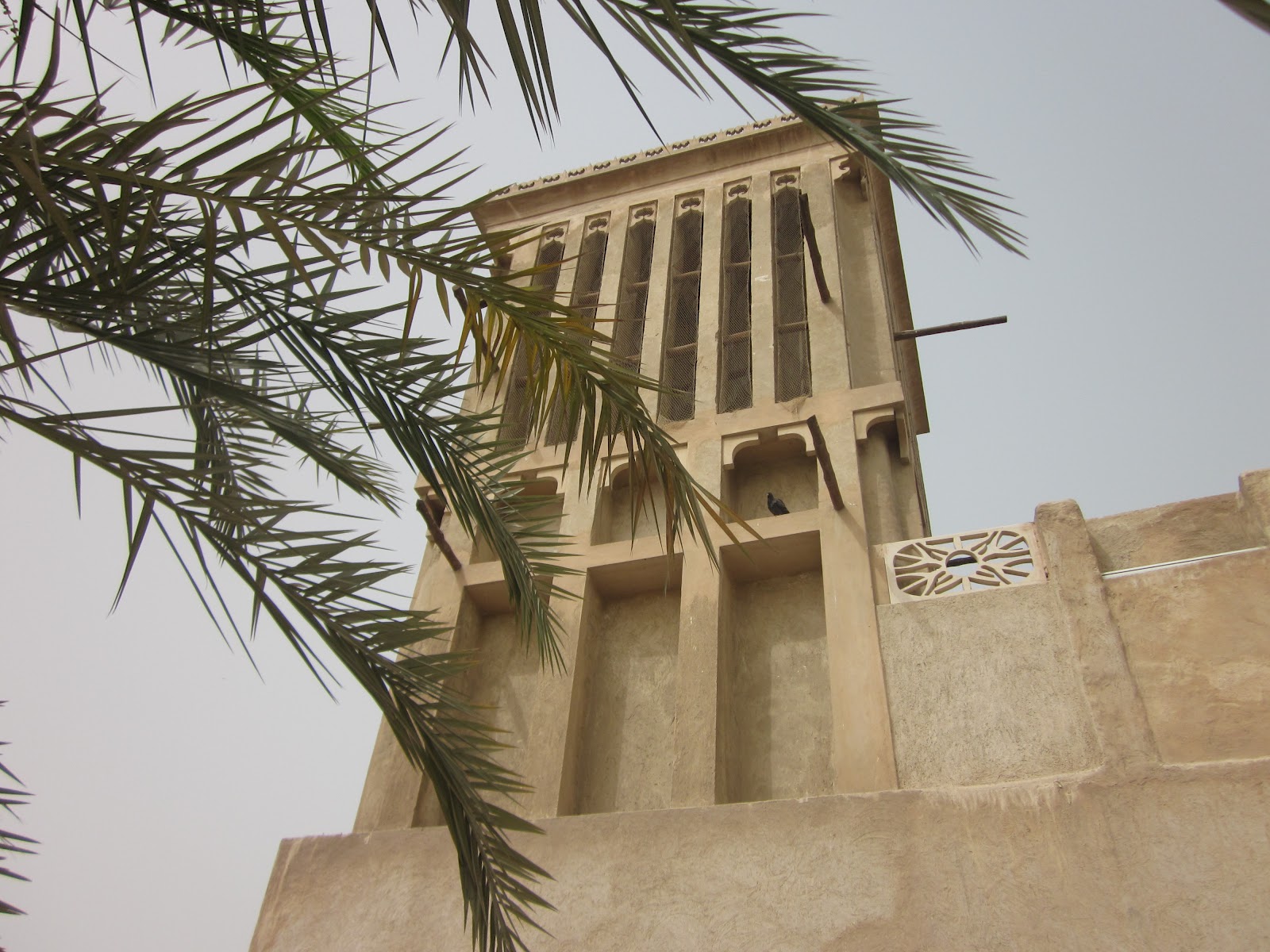
 We also went through the almost pitch-black Dubai Museum (apparently dioramas of what Dubai used to be like) housed in the city’s oldest building (Al Fahidi Fort from 1799), wondering why (since everything is brand new) it had to be so damned dark. Amazingly we managed to get to the exit without harming ourselves, others (more or less – there were a few muttered curses), the scooter or the exhibits – which we could not and did not see. GRRR. More satisfying were the old sand colored houses with wind towers that brought in cooler air before AC arrived here…and which have not been torn down.


…but the gold wares were in rows of tiny glass-fronted modern shops. And certainly not offering bargain prices. The best part was the incredible array of dress; people from all over the globe were shopping (or at least window shopping). The sight that grabbed me most (while I was ogling a 24k gold frog brooch) was a woman completely draped in a black abeyya (her eyes were not covered but she was wearing large sunglasses) who entered the mini-store, pointed after a minute to a bracelet, removed a thick wad of US bills from under her voluminous clothing and peeled off a very large stack of $100.
Bill felt better the following AM so we went into one of the malls…a very upmarket one, just like any glitzy US version except for the shoppers. I wanted to get a photo of this group of friends in front of Victoria’s Secret where they had stopped but one has to be very careful about taking photos of Muslim women – it is not just offensive but might draw down the ire of the watchful eyes of the police.


We have now seen Dubai and need not ever come here again.

Wooden dhows were at anchor in the harbor. This type of ship has ploughed the waters around the Middle East since trading started eons ago. (Poised at Muscat is, geographically, it has been an active port more or less forever.)

About the size of Italy but with far, far fewer people, modernity has been slow to arrive in Oman tho some of the good things that come with the 20th/21st C have been introduced – with alacrity. Oman has a fascinating history of ups and downs. As far back as 5000 BC, Oman was at the center of the frankincense trade (this is where the Queen of Sheba got her gift of it for King Solomon); it is sap from frankincense trees! Copper then became king…but the country became isolated until Islam was introduced in the 7th C. It then puttered along and was engulfed by the Portuguese for about 150 years till mid 17th C. The Portuguese were only interested in the coast (from which they could control their maritime interests) and never went inland; after they were driven off, things improved and by the19th C, Oman had created quite an empire – including Zanzibar and Mombasa in Africa and parts of India. It went downhill again and sunk into another period of isolation, kept that way by the father of the current Sultan who was afraid of his country losing its traditional values.
However, trouble was brewing in the 60’s mostly due to Marxist guerillas encouraged by neighbor Yemen and, to ward them off, a more or less bloodless palace coup occurred (the old Sultan was shot in the foot, deposed and packed off to England). The son (educated in England) then built hospitals and schools and created a more up to date infrastructure (roads) and opened his country up to tourism. Thus, we are here. There is only limited oil here so Oman has not gone the way of Abu Dhabi and Dubai…Omanis (both sexes) do their own work and the country is doing nicely, not over the top like its UAE neighbors. It got our vote. Nice main street with parking set aside for the Imam.


Bill’s first excursion since he developed pneumonia weeks back took us outside of the city to the Sultan Qaboos Grand Mosque. However, we infidels arrived too late in the AM to be allowed inside and had to content ourselves with just looking at the structure and the date palm oasis in which it sits (dates are still a major export).


We also visited the modern government buildings…the people were much more fun to see.

Muscat Museum which had walls devoted to firearms as Oman used to generate a chunk of its revenue from arms sales.

I can’t say we were particularly struck by anything probably due to the stampeding hordes of Asian tourists; photos were verboten…something I didn’t realize at first.
One of the sources of Oman’s money in the distant past – but still on offer – is frankincense and myrr! So, when we visited the souk, that was what we saw a lot of. We also saw a great many men in their white shirt dress (dishdasha) and small fitted brimless headgear. The women were all wearing abeyyas but face covering styles vary (the photo with the two women has a handsome backdrop of Muscat). Bill’s scooter drew a lot of attention and started a number of conversations.


After we returned to the ship (Bill was totally wiped out but had done well for his first outing), I went back to the souk and took more photos (and also found a cheap but stifling internet café where I worked and watched the sunset). This fellow initially said NO to my request for a photo but then started talking and was quite friendly, ending with an insistence that I take his photo which he wanted to see.

And for reasons undivined, the ship spent the night in port, leaving in the AM. There was a sand storm afoot so the photos in the early light were quite ethereal. I got a little carried away with the photos. (I recently took a class on board in how to take better photos of structures…not sure if it shows.)


We then headed for Abu Dhabi (which means Father of the Gazelle of which there used to be many but now they hide up in the hills). To get here from Oman we sailed west thru the Strait of Hormuz in the daylight and perhaps that was part of the reason we stayed overnight in Oman. We are now in the Persian Gulf!
There are seven states in the federation that make up the UAE but all except the two we are going to see were completely unknown to our ears. Large – really large – photos of the sheikhs who head the states are publicly displayed (the one running down the side of a modern building is of all seven; the other we think is of the main movers and shakers, the heads of Dubai and Abu Dhabi).


Abu Dhabi and Dubai were rather small potatoes for a long time, with the pearl industry being a major revenue generator until the Japanese came up with cultured pearls in the 1930’s and decimated it; fishing and dhow building were also part of the economy. Britain had agreements/truces with all of the Emirates (collectively known as the Trucial States, protection in return for exclusive rights) but these withered in the 1960’s.
Bill stayed on the ship today, resting for Dubai. The pleasant surprises started just off the gangway, with a flurry of welcomes…falcons (with and without their charming little hats), traditional coffee and dates, dancing and singing men (they are in regular clothing, not costumes and this was NOT a vaudeville routine – they were in earnest), and a well-furnished and large tent where heavily veiled women were making something like flatbread. (Notice the woman on the right who looks like Groucho Marx – this is a type of face covering.) This was a delightful entry!


First up was the Sheikh Zayed Grand Mosque…well named. It was immense…the world’s 3rd largest mosque and surely the most costly.


Before being allowed to enter (at least they let us in), we women were suited up in the traditional and obligatory black head to toe abeyya; I relented and other than tripping quite a bit, found it rather nice – you can really hide in these things! I also had trouble keeping the scarf firmly covering my hair and was given several tongue lashings when it slipped.


The exterior walls looked like those of children’s seaside sandcastles.

This captivating ceiling is made from palm trunks cut by hand from the markings and reeds. Note the macramé chairs and guest quarters.


And toured a date palm plantation to see the ancient Falaj water irrigation system. This was a much larger and (now) concrete version of the irrigation that is everywhere where there is greenery. Many of the streets are lined with flowers and shrubs and trees but that’s it…there is sand and desert where there is no ongoing irrigation (there must be millions of miles of black plastic tubing). Mercifully we were then let loose on a glorious spread of traditional Middle Eastern food – in a Hilton that had sense enough to build here in 1970. Unfortunately all we wanted to do then was nap – preferably in the shade – but instead were herded back on the bus.
We livened up, however, on reaching the camel market! These are all manner of camel (dromedary)…racing (the most costly), working, and those to be eaten. (I had eaten camel in Tunisia when I, if not the camel, was younger – you only eat the camel when it has reached an advanced age.) The highlight was a 2 day old baby…incredibly long and white legs. As well as a slightly older but still nursing camel…and lots of other camels…and their keepers none of whom would be citizens.


Camel racing is quite the thing here and children were used despite the accidents. (This is the reason that in Oman foreigners are not especially welcome at the races.) Small adults have been tried but have been or are being replaced by radio-controlled robots…truly. On the way back into the city, we were shown Ferrari World, the largest theme park in the world and home to the country’s grand prix (local Ferrari owners and those with other megabuck cars are allowed to test drive the track).
That evening we slipped the short distance to Dubai, our second port in the UAE…and something Bill had longed to see. I figured it would be a lot like Las Vegas – and it was, but with bottomless and new money. It was amazing to see – in the sense that it has everything that money can buy; nothing is old.
The sand storm that began the day before yesterday is beginning to settle down but the air is hazy with fine particles. From the ship, the view of the city looked like NY (well, NY with minarets on the skyline) on a slightly snowy day, sand taking the place of already fallen snow.
While the country was doing quite nicely before oil was found in the early 60’s (the economy was based on trade, some of it illegal) and the British finally left in the early 70’s, the ruling family wisely realized that their grandchildren would be back in the desert on camels if something drastic was not done about revenue as the oil and gas would not last very long. So they started thinking outside the box and came up with TOURISM – truly in upper case letters. World class hotels, horse and camel racing, beautiful beaches and endless malls (as well as souks)…shopping is king. They were in the middle of a month-long Shopping Festival during our visit. We visited the hotel the image of which has become iconic. This is the Burj Al Arab, shaped like a billowing sail and built on a circular man-made island. Very expensive! Dubai is big on creating islands and turning them into very, very expensive real estate. (We had planned to go see Palm Island – three man-made islands in the shape of a palm, where the “fronds” are studded with pricey dwellings – later today, but Bill was not up to it.

Another mosque…we are now mosqued out, especially after the over the top one we saw yesterday in Abu Dhabi. I now know the five pillars by heart (Shahada: there is one god, Allah; Salat: face Mecca and pray 5 times a day; Zakat: give to the poor; Haj: make a pilgrimage to Mecca; and Ramadan: fast during this religious observance which shifts in time every year because of the lunar calendar). The Islamic law, Sharia ‘a is still in vogue and probably accounts for the very low crime rate (and certainly the lack of graffiti); there really is zero tolerance for deviations. It is still OK to have more than one wife BUT the modern men feel that the need to treat all wives exactly the same pretty much rules out having more than one (it would be very expensive)…so it is out of fashion (except perhaps for the ruling sheikhs).

A highlight was crossing the Dubai Creek (which divides the city) on an abras (water taxi)…cheap, breezy and not covered by any insurance in case of passenger mishap. A relic of past times somewhat strange in this ultra-modern place.

I had been looking forward to seeing the Gold and Spice Souks because of the memory of what they can be like from my time in Tunisia…and from the recent one in Muscat (tho it too was modernized). The spice market had some charm…

…but the gold wares were in rows of tiny glass-fronted modern shops. And certainly not offering bargain prices. The best part was the incredible array of dress; people from all over the globe were shopping (or at least window shopping). The sight that grabbed me most (while I was ogling a 24k gold frog brooch) was a woman completely draped in a black abeyya (her eyes were not covered but she was wearing large sunglasses) who entered the mini-store, pointed after a minute to a bracelet, removed a thick wad of US bills from under her voluminous clothing and peeled off a very large stack of $100.
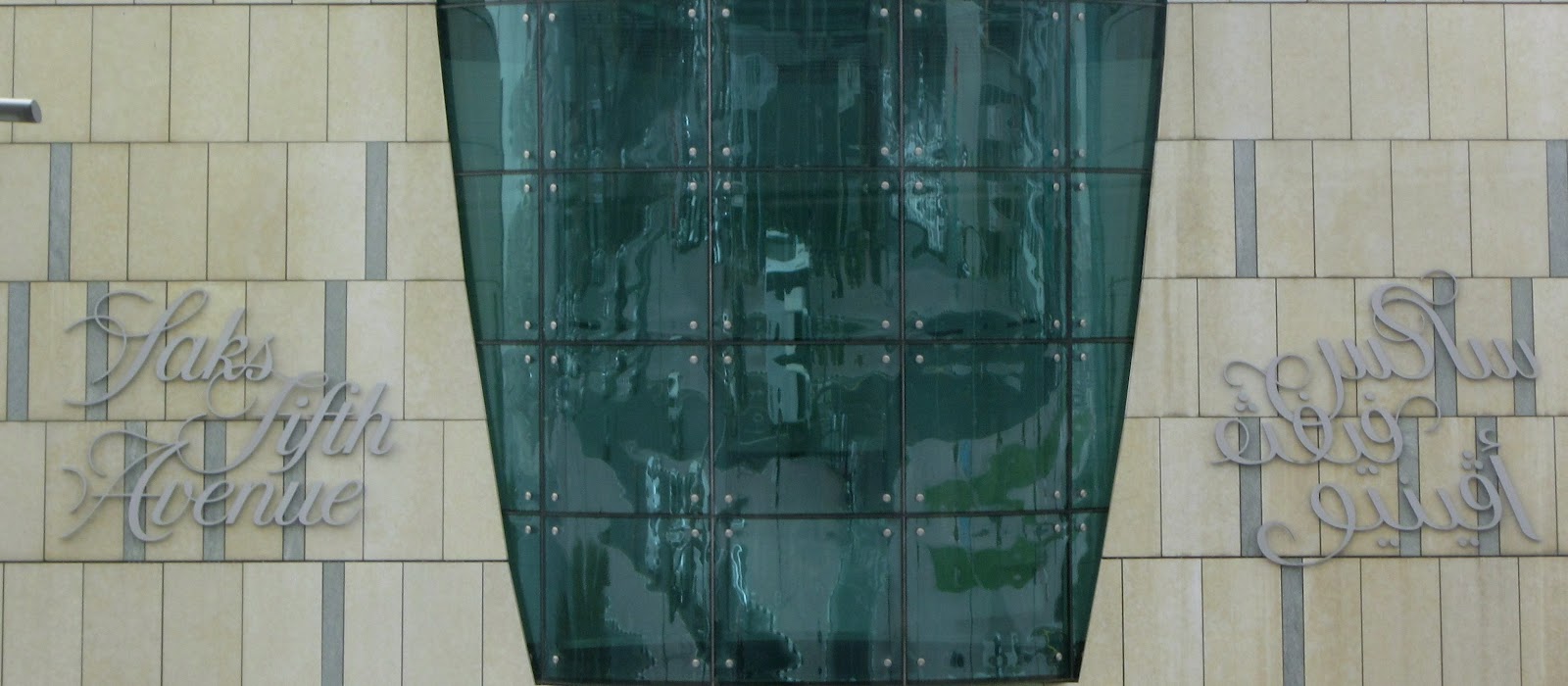
Bill felt better the following AM so we went into one of the malls…a very upmarket one, just like any glitzy US version except for the shoppers. I wanted to get a photo of this group of friends in front of Victoria’s Secret where they had stopped but one has to be very careful about taking photos of Muslim women – it is not just offensive but might draw down the ire of the watchful eyes of the police.

We have now seen Dubai and need not ever come here again.
Ahead of us was a long stretch of five sea days as went back through the Hormuz Strait (the two one-way channels are one mile wide) separating us from Iran, and then paralleled the coast of Oman. At that point, we passed into the Gulf of Aden off of Yemen (where there is a lot of unrest we want no part of) to the north and Somalia to the south (don’t want to go there either). Into the Red Sea (immense), we also sailed by the tiny country of Djibouti and larger Eritrea…neither one do we know anything about; unsure where Moses parted it but we were later told that it was not actually the Red Sea but rather a muddy lake far to the north. Saudi Arabia stayed off our starboard for several days, with Sudan off our portside (Khartoum being just inland about 400 miles)…again, exciting places that we forego. The days passed quickly and tended to run into each other like a watercolor. Mercifully, no pirates!


